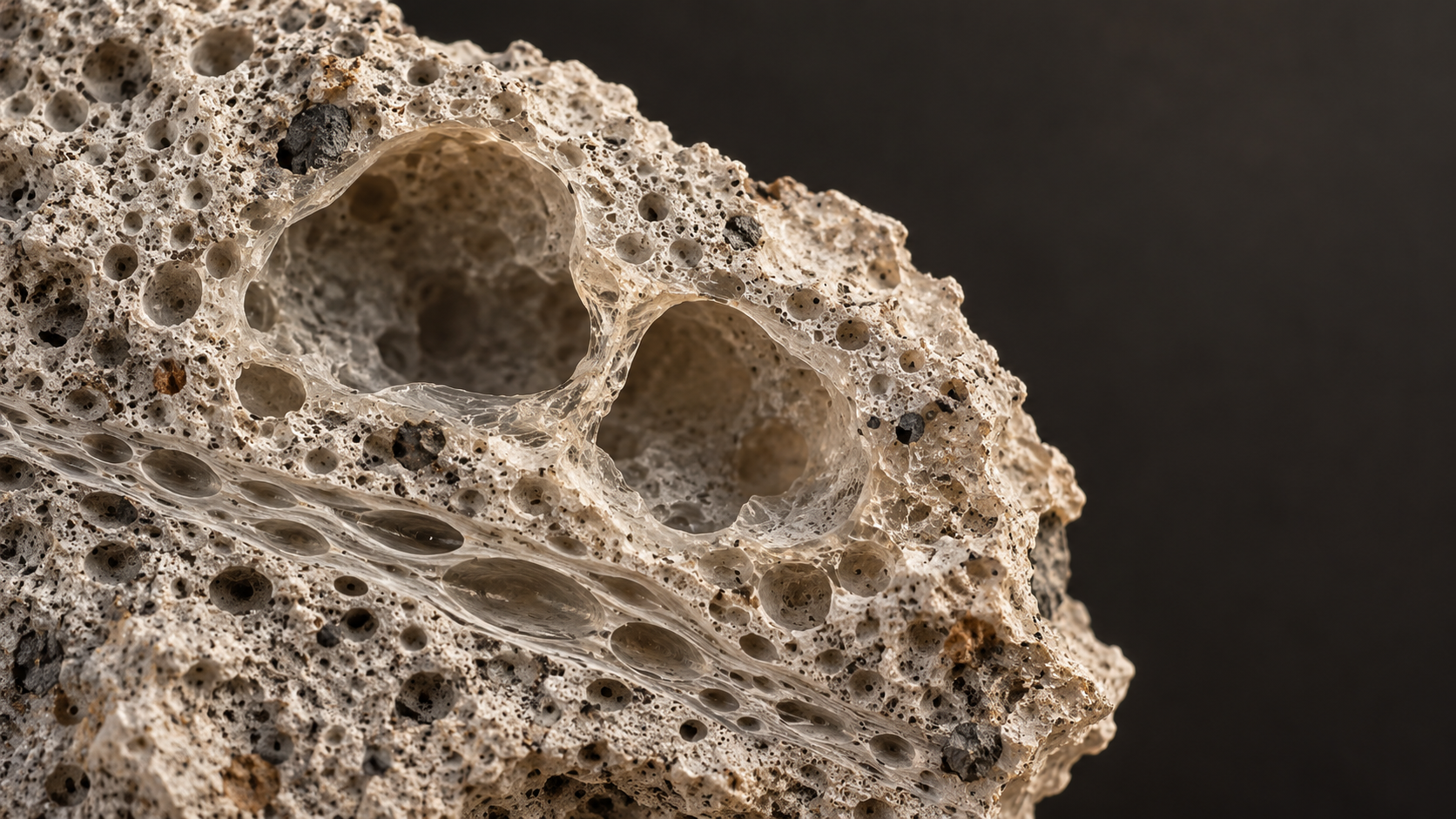
A piece of pumice can look almost more like air than stone. Under a lens, its glass is a thin web around cavities of different sizes: round pinholes, stretched openings, passages that join one chamber to the next. Those cavities are vesicles, the spaces left by gas in molten rock. They invite a tempting reading. Find the biggest bubbles, and perhaps you can tell how long the magma rose; find the smallest, and perhaps you can tell how violently it erupted. The glass holds a record, but it has been written over several times.
The first useful distinction is between the gas and the glass. Water and other volatile substances can be dissolved in magma at depth. As pressure falls during ascent, the melt can hold less of them. Gas begins to form bubbles, and molecules diffuse from the surrounding melt into those bubbles. The bubbles may expand while the magma is still moving. If cooling stops that movement before the spaces close, the solidified glass preserves their outlines. A cavity in a hand specimen is an absence now, not a sample bottle of the gas that originally occupied it.
How a bubble begins matters
The fall in pressure does not produce a uniform spray of identical bubbles. A new bubble needs a place to begin. In high-temperature decompression experiments on rhyolite and dacite, Margaret Mangan and colleagues found that the pressure change needed to trigger bubble formation differed with melt composition and with the way gas could gather at crystal surfaces. Some mineral surfaces made favourable starting sites in the tested rhyolite; others did not. The same amount of dissolved gas therefore need not make the same pattern of holes in two magmas.
Laboratory work also clarifies why there may be a burst of tiny vesicles rather than steady growth of a few large ones. In experiments with water-bearing rhyolitic melt, Helge Gonnermann and James Gardner studied how bubbles formed as pressure dropped. The melt could become supersaturated: it held more dissolved volatile material than it could retain at the new pressure, yet a gas bubble still had to overcome the cost of making a new surface. The researchers measured bubble populations and tested a model of that barrier. Their work makes bubble number useful evidence of nucleation conditions, while showing why a simple count cannot be turned directly into an ascent speed without assumptions about the melt.
Size brings another clue, and another caution. In a 1982 study of pumice from five Plinian deposits, R. S. J. Sparks and S. Brazier reported three groups of pore sizes. They interpreted them as gas forming on different time scales, from relatively slow development before ascent to rapid formation near or after disruption. That was a powerful way to ask what a size distribution might mean. It was an interpretation of those samples, however, not a universal rule that every large hole began deep or every small one at the surface. Bubbles can grow after they first appear, and two neighbours can become one.
A hole can outlive more than one bubble
Consider the thin wall between adjacent gas spaces. As the bubbles expand, the wall may break and the spaces join. Gas then has a path through the rock rather than a collection of sealed rooms. In pumice from the climactic Mount Mazama eruption, C. Klug, K. Cashman and C. R. Bacon measured highly interconnected pore space and examined a separate population of large vesicles. They argued from the textures and size distribution that those large spaces had formed mainly by coalescence. A large cavity in that pumice was not necessarily a single old bubble; it could be the shared room left by several younger ones.
Connectivity changes the eruption as well as the specimen. Gas trapped in isolated bubbles can press on the melt around it. Once enough openings connect, gas may escape through a permeable network. The balance among expansion, escape and rupture helps determine the texture that survives. In a study combining pyroclast measurements with physical analysis, Alison Rust and Katharine Cashman compared pumice and scoria and stressed that preserved vesicularity is shaped by when permeability develops. A rock full of holes is not automatically a rock through which gas once flowed easily: narrow throats, broken walls and the arrangement of openings matter.
Shape, too, can register movement after a bubble forms. A round cavity may be pulled into an ellipse or a long tube as viscous magma flows. Surface tension works in the other direction, tending to make the bubble round again while the melt is still mobile. Rust, Michael Manga and Cashman's study of obsidian used bubble shapes and orientations in several samples to investigate different kinds of shear. Their point was more exact than “long bubbles show which way the lava went.” Reading flow from a vesicle requires knowing how the melt deformed and whether the bubble had time to relax before the glass set. Orientation can be evidence of flow; it is not a compass arrow printed without conditions.
The cut surface is only a slice
A polished section introduces a further problem. Slice a sphere away from its middle and the circle on the surface looks smaller than the sphere. Slice a stretched or branching cavity at a different angle and its outline may suggest another shape altogether. Two dark marks on a section may connect outside the plane of the cut. This is why a photograph of one surface cannot give the full three-dimensional population without reconstruction or careful statistical correction.
In X-ray microtomography of pumice and scoria, Margherita Polacci and colleagues rotated clasts through an X-ray beam and rebuilt their internal spaces in three dimensions. They measured the volume, number and connectedness of vesicles rather than relying only on flat outlines. Among the samples they studied, clasts with comparable amounts of empty space could have different permeabilities, consistent with differences in the geometry of their connected pathways. The lesson is practical: the fraction of rock occupied by voids and the ability of gas to travel through those voids are related questions, not identical measurements.
Nor is one hand-picked pumice clast a whole eruption. Measurements from six silicic eruptions at Raoul volcano found wide differences in density, bubble size and bubble number even among clasts from a single eruption interval. The authors cautioned that the most common density class, often chosen for detailed study, may already have undergone bubble growth and merger. To reconstruct an ascent history, investigators sample a range of clasts and set those textures beside deposit position, melt chemistry and other evidence. The variation is itself part of the result.
There is a still stranger complication in volcanic glass. In a study of obsidian fragments from an explosive-to-effusive sequence, Janine Aubin and coauthors described rounded, elongated and distorted voids while examining the alignment of tiny crystals. They inferred that some oddly shaped spaces began between ash fragments that had fused together, then were stretched or rounded during later movement. In such a rock, calling every void a bubble born in continuous liquid magma would erase an entire stage of its history.
Even the familiar association of airy pumice with violent explosion has limits. Clasts dredged from submarine Macauley volcano led Melissa Rotella and colleagues to propose that highly vesicular magma could detach buoyantly underwater without the vigorous fragmentation usually imagined for pumice. The interpretation concerns that setting, where surrounding water pressure and transport complicate the story. It makes the broader point clearly: the texture of one clast does not name the eruption style by itself.
To read a volcanic glass, then, begin with the spaces but keep their sequence open. Count how many there are and how sizes vary. Ask which cavities join, whether their long axes align, and whether a two-dimensional view has hidden a connection. Compare clasts rather than appointing one specimen the spokesman for an eruption. A vesicle is an unusually intimate trace of magma's journey: gas came out of solution, a bubble or opening changed shape, and cooling preserved what remained. The skill lies in seeing the steps that could have made that final shape without pretending that the glass has recorded only one of them.
A thought worth keeping?